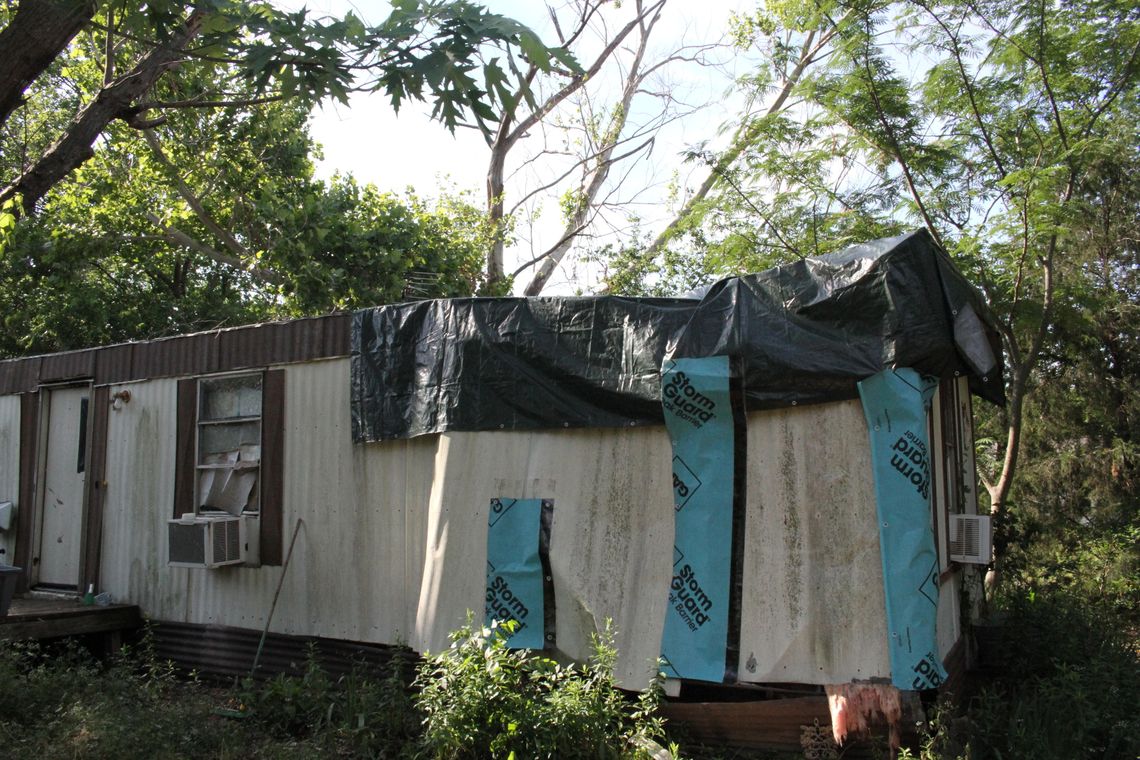
Texas Health Resources will provide two full-time case managers to assist Springtown residents recovering from the April 25 tornado by reallocating funds from its existing Hands Up for Mental Health community impact grant.
The Hands Up for Mental Health grant ends in December and was originally awarded to support mental health access and address food insecurity in Springtown through Safe Harbor Counseling, First United Methodist Church and Joyful Ranch Counseling.
“This is just organically happening — you can’t plan a storm,” said Melanie Nieswiadomy, program manager of Community Health Improvement at Texas Health Resources.
Nieswiadomy said the case managers are currently being onboarded and are Springtown residents familiar with the community.
“I love that one’s a retired teacher and one’s a retired football coach — a male and a female,” she said.
“You got this beautiful dynamic because we don’t know who we’re going to be engaging with. We know that community impact grants have the most success when people engage with those that know each other — those who we have trust and a relationship with,” Nieswiadomy said.
The decision to reallocate funds from the existing grant came through Nieswiadomy’s weekly conversations with organizations involved in the long-term recovery program.
The program was recently launched by United Way of Parker County in partnership with the United Methodist Committee on Relief and local community organizations, including Texas Health Resources.
While UMCOR has expertise in helping communities manage long-term disaster recovery, the grant application process to provide case workers to the community may cause delays in getting help to storm victims.
“UMCOR has this amazing experience of helping with disasters,” Nieswiadomy said.
“They start talking to us about these awesome grants that they can apply for that can help get case managers on the ground and assess those community members. But that could take some time; it could take three months. I said, ‘We have this grant we can use. The church already has the fingers on who’s in need in the community. We can use the current funding that would be an extension of those who are impacted by the storm,’” she said.
After the conversation with UMCOR, Nieswiadomy said Texas Health’s council unanimously approved using a portion of the grant to fund the two case manager positions.
Texas Health will cover the first three months, allowing case managers to begin assessing needs before UMCOR funding becomes available.
Nieswiadomy said the case managers’ work will help the long-term recovery group members gain a clearer understanding of how many people were affected and what assistance they still need.
She said the case managers’ work will include helping residents process documents, assessing household needs and connecting them with organizations that may have the appropriate resources.
“We’re not talking social work case managers,” Nieswiadomy said.
She noted the case managers could help assess needs such as property damage, insurance deductibles, housing instability, food access or lasting mental health effects of the storm.
“There are so many layers,” Nieswiadomy said.
“It can be anybody. There are people who don’t have homes or they’re renting a mobile home — they don’t qualify for certain benefits. It could be somebody who was already struggling, whether it was finding a job. It could be somebody with no food on the table to those who can’t pay extremely high deductibles,” she said.
The case managers will be based at First United Methodist Church, 109 W. Third St., but Nieswiadomy said their work will extend into the community, including rural areas where residents may be harder to reach.
“I believe it will be very unconventional,” she said.
“Together, both case managers could go into certain areas and knock on doors. They could meet people at a McDonald’s. I don’t think we should put limitations on how people can be reached. Whatever it takes,” Nieswiadomy said.
As the case managers become established in Springtown, residents with immediate storm recovery needs can contact the long-term recovery program through United Way of Parker County.
Residents can email Executive Director Jana Snow at [email protected] or call 817-458-8615.