CARLA NOAH STUTSMAN
Three Springtown women collaborated on a bold project aimed at documenting Springtown’s long history as a ranching and farming community in an era of explosive growth in the area.
Mary Harms and Judy Ray are both longtime business owners in the community who are active in the Springtown Area Chamber of Commerce. Both still live and work on farms their families have owned for generations. About a year and a half ago, the two women had an idea to commission a mural that would honor Springtown’s agricultural history.
“We wanted something special for the farmers and ranchers of our great town,” Harms told the Springtown Epigraph. “We wanted to let the newer residents know what, when, where we are rooted.”
Ray reached out to local artist Faith Shipman, who worked in the early morning hours through the hottest part of the summer to bring Harms’ and Ray’s vision to life. The result is displayed on the south-facing wall at the Springtown Flower Shop — a business Harms owned and operated for 33 years. Although she eventually sold the business, she continues to own the building, as well as the professional building across the parking lot from it.
Ray and Harms said they always knew they wanted Shipman to be the artist and were so happy when she agreed.
“She just makes whatever is there beautiful,” Harms said.
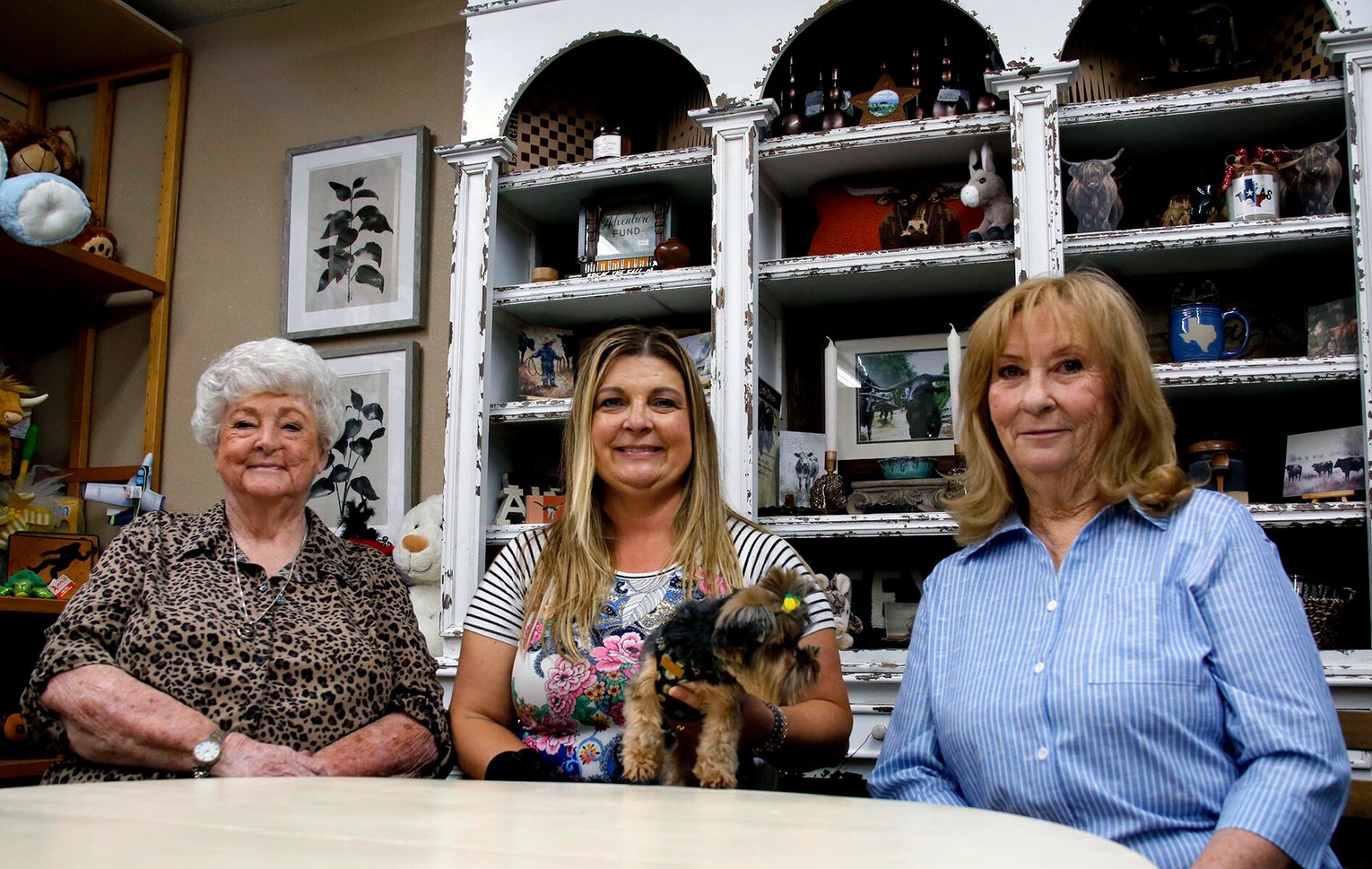
The three women — and, of course, Ray’s faithful sidekick Daisy, a Yorkshire terrier — gathered at the flower shop on a recent evening to share the story behind the mural.
THE HISTORY
According to Ray and Harms, Springtown and the area surrounding it were built on agriculture — especially dairy farms. Although most of those farms no longer exist, descendants of the families who owned and operated them remain in the area and proudly call Springtown home.
“Each of those farms operated with between 50 and 200 Holstein or Jersey dairy cows, and families not only produced milk for the surrounding communities, but they also grew hay and grain to help keep their operations running,” Harms said. “Most farms were equipped with John Deere tractors or horse-drawn wagons.”
Many of the roads around Springtown owe their names to those farming families: Harms Drive, Sandlin Lane, Holbrook Road, Christenberry Road, Gilliland Road and Dobbs Trail are a few examples.
According to Harms, farmers sometimes donated gravel to aid in the construction and maintenance of the roads that led to their farms to help the milk trucks make their rounds.
Springtown High School is actually built on property that was once a dairy farm, Harms said.
But farming was not the only contribution farmers and ranchers made to the community. According to Harms, many of them were leaders who served as directors on school, college and church boards, soil and water conservation boards and livestock improvement associations.
“The heart and soul of Springtown were its farmers,” Harms said, adding that even though there are no more dairies and very few farms still operating in Springtown, they are still a rich part of the town’s history.
THE PLAN
Harms and Ray considered different sites for the mural, but in the end, they chose the Springtown Flower Shop because they felt more people would see it there. Because it faces State Highway 199, more than 35,000 people have an opportunity to view it each day as they travel or commute to and from the area.
“It’s probably a better site than what we originally wanted because of all these cars that go by here,” Ray said.
The two women brainstormed their ideas and came up with a list of “must haves” for the mural.
“Well, it’s got to have some Holstein cows because our family raised Holsteins,” Harms said. “And Judy did Jerseys, so it’s got to have those.”
Ray began to put their ideas together using artificial intelligence, and as ideas came about, she added and changed it up.
After making the decision to put the mural at the Flower Shop, Harms asked Ray to call Shipman to see if she could paint it.
“Judy called back and said, ‘Yeah, she’ll do it.’ So, I said ‘Then let’s go for it. Let’s do it.’”
Shipman — whose portraits, animal portraits and murals can be found in homes, businesses and even vehicles in the area — came armed with ideas, too, which were incorporated into the plan for the mural. Then, over the summer, the work began.
THE TRIBUTE
Shipman’s mural truly brought Harms’ and Ray’s vision to life, and all three feel it honors all the things the Springtown community was built upon: agriculture, as well as a strong, successful family-centered atmosphere.
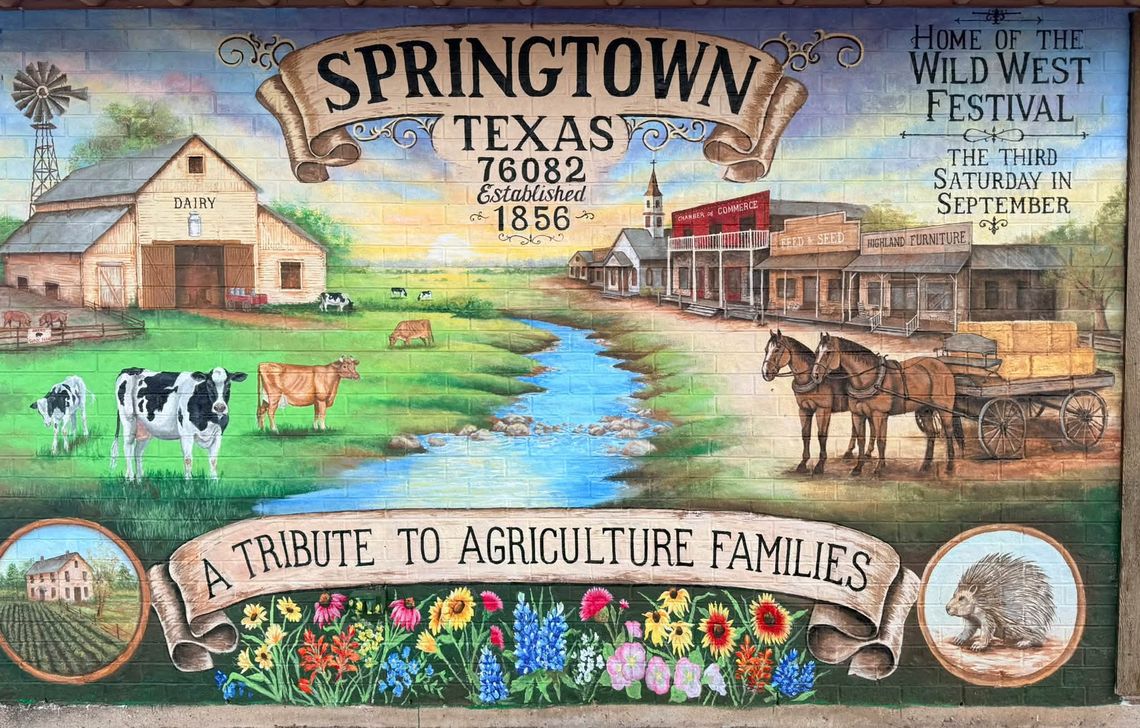
The mural depicts Walnut Creek running through the center of town and features a dairy farm, complete with Jersey and Holstein cows, pigs and a windmill on one side of the creek. On the other side is a horse-drawn wagon carrying hay in front of a rendition of the Springtown Square in its early days, including a church, the Springtown Area Chamber of Commerce, a feed store and even Ray’s business, Highland Furniture.
Ray is quick to point out the business didn’t even exist in those early days, but she appreciates that Harms and Shipman wanted to include it.
The mural also features a home with a garden, the wildflowers that grow so prolifically in the area, a porcupine — an homage to the Springtown High School mascot — and a reminder that Springtown is the “Home of the Wild West Festival.” Shipman even painted window boxes and the remaining part of the wall not covered by the mural to look like aged wood fencing.
Its bright colors, the movement of the creek, and a setting sun in the distance draw attention to those passing by and evoke the history, heritage and legacy of the people whose hard work and devotion to the community gave way to what Springtown is today.
THE INVITATION
Harms, Ray and Shipman say they are thankful to have completed the project, and they are happy with the result. They say it was important to them to portray Springtown’s history and to honor the legacy of its farmers and ranchers. They invite the public to stop by and take a picture with the mural.
It’s their gift to the community.